
Day-by-Day Itinerary
Day 1 — Arrival in Ulaanbaatar
Arrive at Chinggis Khan International Airport in Ulaanbaatar, Mongolia's capital. Check in, freshen up, then join the group for dinner at a traditional Mongolian restaurant — authentic flavors and a first taste of local cuisine. In a quiet room at the restaurant, your Group Leader greets everyone, leads introductions, and reviews the trip, safety guidelines, and emergency procedures. Overnight at a hotel in the heart of the capital.
Day 2 — Ulaanbaatar: Chinggis Khan Museum & Gandan Monastery
Begin at the Chinggis Khan Museum for an immersive journey into Mongolia's deep historical roots — the life and legacy of Genghis Khan and the Mongol Empire. Continue to Gandan Monastery, the largest and most significant monastery in Mongolia and a window into the country's Buddhist heritage. A walk around Chinggis Khan Square in front of the Parliament House shows you the modern pulse of Ulaanbaatar. Dinner at a local restaurant; overnight at the hotel.
Day 3 — Hustai National Park: Wild Przewalski's Horses
Drive west (60 km asphalt + 20 km dirt road) into wide-open Mongolian landscapes to meet the Przewalski's horse (takhi) — the world's last truly wild horse, native to Mongolia and successfully reintroduced to Hustai in the 1990s. An afternoon exploration and documentary at the Hustai museum adds context to the park's conservation story. Overnight in a yurt camp beside the park, close to nature.
Day 4 — Kharkhorin, the Ancient Mongol Capital
An incredible step back in time: Kharkhorin, founded in 1220 by Genghis Khan, was once a thriving center of trade and culture on the Silk Road. After lunch at the tourist camp, visit Erdene Zuu Monastery — the oldest Buddhist monastery in Mongolia, built in 1585, with its iconic white stupas and intricate temples. Then unwind at your hotel, complete with sauna and swimming pool.
Day 5 — Return to Ulaanbaatar: Cashmere & Culture
After a hearty breakfast, bid farewell to Kharkhorin and drive back to the capital. Late afternoon, visit the world's biggest cashmere store, then take in the Mongolian National Song and Dance Ensemble — traditional songs, dance, and throat singing accompanied by the morin khuur (horsehead fiddle). Dinner at a local restaurant; overnight at the hotel.
Day 6 — Fly to Dalanzadgad, Gate of the Gobi
Fly south to Dalanzadgad, the bustling capital of Umnugovi (South Gobi) Province and the main entry point for the wonders of the Gobi Desert. Small but full of energy, it's the perfect expedition base. On arrival, visit the local museum illustrating why this region is dinosaur land. Dinner of local specialties; overnight at a hotel in the heart of the city.
Day 7 — Yolyn Am, the Eagle Valley
Depart early for Yol Valley National Park, cradled in the foothills of the Altai Mountains — a deep, spectacular narrow gorge in the Gurvan Saikhan range. Walk between towering cliffs where, even in summer, a sheet of ice often survives deep in the gorge — one of the Gobi's most unique natural wonders. Watch for golden eagles, ibex, argali sheep, and small mammals; the valley is a paradise for birdwatchers, and noticeably cooler than the desert beyond.
Days 8–9 — Khongor, the Singing Sand Dunes
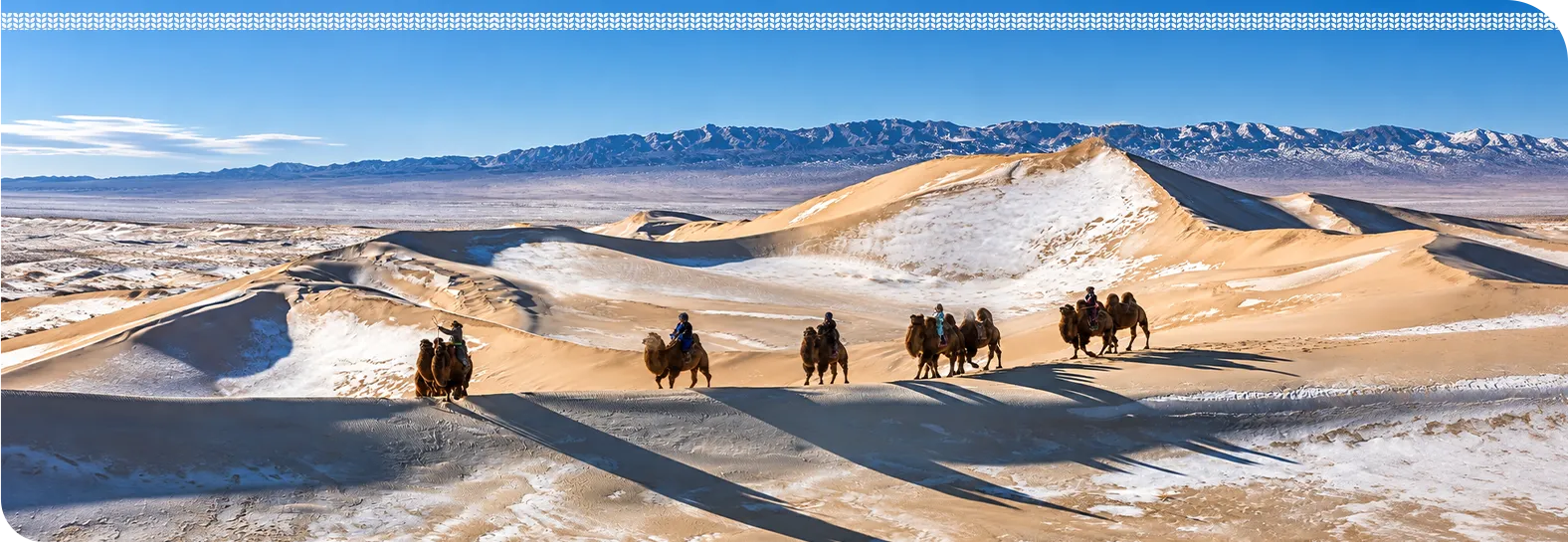
Drive to Khongor, Mongolia's largest dunes — the "singing sands." These monsters stretch over 100 km and reach up to 300 m in height; their nickname comes from the hum of small sand avalanches on windy days, likened to a distant aircraft propeller. With two nights here, take your time: climb the dunes, ride a two-humped Bactrian camel along the ridgelines, and stargaze under one of the best night skies on Earth. Rise early and you're rewarded with sunrise over an endless horizon.
Day 10 — Bayanzag, the Flaming Cliffs
The namesake day. Hike the rim of Bayanzag with impeccable views over the vast Gobi — the site where Roy Chapman Andrews' Central Asiatic Expeditions uncovered Velociraptor and Protoceratops fossils from 1922 onward. As the sun sets, the cliffs take on a beautiful hue of orange and red; it's absolutely worth staying for the show. Settle into your ger camp for the night.
Day 11 — Fly Back to Ulaanbaatar: Farewell Dinner
Return to the capital as the adventure draws to a close. In the evening, a farewell dinner at a local restaurant — stories, memories, and highlights from an incredible journey across Mongolia.
Day 12 — Departure
Airport transfer for your international flight home — carrying the Gobi with you.
The Gobi, On the Record
- Roy Chapman Andrews’ team recovered dinosaur eggshell at the Flaming Cliffs in 1922; the celebrated nest of intact eggs was found in 1923 — American Museum of Natural History.
- Hustai National Park was established in 1993; the takhi reintroduction there began in 1992 — Hustai National Park.
- The Przewalski’s horse you will look for at Hustai was declared Extinct in the Wild in 1969 and is now classed Endangered — IUCN Red List.
Price Includes
- All entrances to sites and visits in the program
- Domestic flight tickets (Ulaanbaatar ⇄ Dalanzadgad)
- English-speaking tour guide
- Ger/yurt camp costs
- Horse & camel riding
- Hotel in the heart of Ulaanbaatar
- Private vehicles with drivers (vehicle count scaled to group size)
- Airport transfers
- Scheduled meals and snacks during the stay
- Mineral water throughout the trip
- Trip insurance during the stay in Mongolia
Price Excludes
- International transport (flights to/from Ulaanbaatar)
- Extra drinks and food outside scheduled meals
- Personal expenses
Program activities, schedules, personnel, and indicated distances or times may change due to local circumstances. If changes occur, we alert you as quickly as possible.
Gobi Desert Tour FAQ
What is there to see in the Gobi Desert?
The Gobi's headline sites are the Flaming Cliffs of Bayanzag, famous for dinosaur fossils including Velociraptor and Protoceratops; the Khongor Sand Dunes, which stretch over 100 km and rise up to 300 meters; and Yolyn Am (Eagle Valley), a narrow gorge in the Gurvan Saikhan mountains where ice often survives deep into summer. This tour visits all three.
Why is Bayanzag called the Flaming Cliffs?
The large orange-tinted sandstone cliffs appear to be on fire at sunrise and sunset. Paleontologist Roy Chapman Andrews first explored the site in 1922, and it has since yielded major fossil finds including Velociraptor and Protoceratops.
Can you ride camels at the Khongor Sand Dunes?
Yes. The tour spends two nights at Khongor, with time to ride two-humped Bactrian camels along the dunes, climb the sands, stargaze under some of the darkest skies on Earth, and watch sunrise over the endless horizon. Camel riding is included in the trip price.
How do you get to the Gobi Desert from Ulaanbaatar?
On this tour you fly from Ulaanbaatar to Dalanzadgad, the capital of Umnugovi (South Gobi) Province and the main gateway to the Gobi Desert. Domestic flights are included, and travel within the Gobi is by private vehicle with experienced drivers.
How many days do you need in the Gobi Desert?
Plan at least four to five days to see the Gobi's three headline sites without rushing. This itinerary dedicates five days in the south — Dalanzadgad, Yolyn Am, two nights at the Khongor Sand Dunes, and the Flaming Cliffs of Bayanzag — using included domestic flights so no time is lost on the 550 km overland approach.